
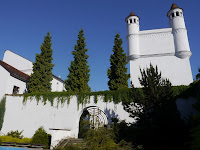
 I don't think I've ever seen a more unlikely buttress than the one that leaps up to support the side of this old Gothic church. Does anyone know where it is?
Friday, 11 November 2011
Where the Czech...? #159

Tuesday, 8 November 2011
Between two churches...

Frýdek-Místek is a city of around 60,000 inhabitants that straddles the Ostravice river about 18km (11 miles) south of Ostrava. The river here forms the border between the old historic lands of Moravia and Silesia and the hyphen might be a clue that Frýdek-Místek was once two towns. Frýdek chateau sits atop a high rocky outcrop on the eastern, Silesian side of the river; Místek was founded to watch over the lower, western, Moravian side of the river crossing. The two tiny historic town centres of Frýdek and Místek are now surrounded by a sprawl of everything that was good and bad about the architecture and town planning of the socialist era. The high density apartment towers are separated by generous green spaces and the wide footpaths, tunnels and courtyards make it easy for pedestrians to get to either old town or the the bus and train stations that are just on the Frýdek side of the river. Unfortunately though, the lawns and gardens are unkempt, the pathways are crumbling and littered and the ground-floor shops that should have been grocery stores, hairdressers and newsagents have devolved into dark and mostly deserted non-stop bars filled with flashing lights and hypnotized gamblers.
Luckily there's more to Frýdek-Místek than its bedraggled suburbs and most visitors will probably spend their time in one or both of the historic old towns. The street layout of both is preserved. Místek is the smaller of the two and just off the tidy marketplace square stands the most impressive building. The church of St. James was originally Gothic but the striking red and white plaster and pear-shaped copper dome are from a later reconstruction in the baroque style. Many of the houses around the old marketplace square are quite attractive and one side has a beautiful long arcade walkway from the 1500's. There are some insensitive and ugly buildings on the square too, and because the old town of Místek is so small, you really only have to walk one block to be among the grimly oppressive pavilions that sell discount clothes and house a hard-to-comprehend number of seedy all-night gambling bars.
 Across the river in the shadow of the imposing Basilica of the Assumption of the Virgin Mary, Frýdek's old town does a better job of shrugging off the surrounding urban grimness. No doubt it's helped by its position atop a relatively steep-sided hill and the loosely connected ring of parks that cushion the impact of the communist-era architects. The imposing chateau that stands over the western end of Frýdek's slightly sloping rectangular square is open to the public six days a week and the courtyards and formal park are free of charge.
 The rest of the Frýdek square is lined by two, three and four storey townhouses in varying architectural styles, and they seem to house the best of the city's best cafes, restaurants, penzions and shops. My particular favourite is the Frýdek-Místek teahouse (at Hluboká 64).
 If you're not familiar with teahouses, they're inspired by the orient, offer 100 types of tea from across the world and there's at least one in every decent sized town in the Czech republic. I'm not sure what makes the Frýdek one so special but everyone I've taken there seems to agree it has a certain something. It's long been my favourite teahouse but if anyone thinks they've been to a better one, please post the address in the comments below because I'd love to check it out.
7
Friday, 4 November 2011

Friday, 28 October 2011

Friday, 21 October 2011

Tuesday, 18 October 2011
Hats off to Nový Jičín

 The main central square of Nový Jičín is one of the Czech Republic's most attractive. It's almost an equal-sided square and the two or three storey townhouses that line its edge have colourful facades and covered arcades that create an unbroken walkway around the entire perimeter. Not a single building looks out of place and towers of the town hall and the church of the holy trinity add an extra pinch of architectural drama.
 Two of the nicest houses on the square are both towards the corner near the Church of the Assumption. The yellow and white one with the balcony on each floor was originally the town's post office but is now used as shops, a cultural centre and on the top floor an excellent little cafe with seating inside or overlooking the square from the flower covered balcony. Nearby, the sky blue House of the White Angel has the most elaborately decorated of all the street frontages and has served as the town's pharmacy since the early 1700's.
 The plague column in the middle of the square has been recently restored and in front of it stands a small fountain with two dancing characters dressed in the typical German costume of the region. Nový Jičín was a Sudeten German town and if you meet ten locals, you'll probably hear ten different explanations for the figures on the fountain. If you meet the same guy that I met while I was crouching down to photograph it you might even hear a conspiracy theory or two.
 Away to one side of the plague column and the dancing German settlers is a new statue of St Nicholas gazing across towards the church tower. Near his feet lays a large bowl shaped fountain and surrounding it are three small sculptures of apples. I've no idea what they represent but they're cool. I also quite liked the modern coloured lights that play unobtrusively on some the historic buildings after dusk.
 Just off the square the renaissance chateau houses the museum of hats and millinery. Nový Jičín has a centuries long tradition of hatmaking (since at least the early 1600's) including the opening of the TONAK workshops in 1799. Anyone with the slightest interest in vintage clothing absolutely must pay the museum a visit. Darling.
 With good transport links and good range of accommodation for all budgets, Nový Jičín is well worth considering as a base while you're exploring the countryside between Olomouc and Ostrava. Pretty little Štramberk is just a few kilometres away, as is Kopřivnice (and its Tatra automobile museum), Příbor (Sigmund Freud's home town) and the moody ruins of Starý Jičín castle.
Friday, 14 October 2011

Tuesday, 11 October 2011
Trying to like Ústí

Among the rounded hills of the North Bohemian highlands about 80km north of Prague, the city of Ústí nad Labem lies in the valley of the mighty Labe River where the smaller river Bílina joins it on the long journey towards the North Sea. It may sound like a lovely setting for a city, but Ústí has a reputation as being not a very nice place to visit. And as you approach, it’s easy to see why. No matter from the north or south or by train from the west along the Bílina valley, huge industrial and manufacturing zones litter the skyline, hillsides and riverbanks with smoke stacks, silos, conveyor belts and docking cranes.
 Poor Ústí can’t even rely on the saving grace of many riverside cities, their bridges, for a bit of architectural interest or romance. The southernmost of Ústí’s three river crossings is a flat Meccano-like span and the middle bridge with the arched top is little better. Despite its brutal modern design, the northernmost bridge is the most striking of the three. Two high sharp-edged pillars of reinforced concrete rise asymmetrically from the river’s eastern bank and from those, steel cables as thick as a man’s leg fan out to evenly spaced points across the span like the web of a monstrous mechanical spider or one of those string and pin wall hangings your crafty aunt used to make back in the 1970’s.
The old centre of Ústí roughly keeps the original layout of the customs settlement that grew beside the river between the 10th and 13th centuries, but apart from the two churches, there’s little remaining of historic architectural interest. On the main square alone there are five modern buildings of six stories or more. Of them the only one that really displays any architectural grace is the Česká Spořitelna building with its considered proportions and detailed relief work around the entrances. There’s also an interesting mosaic column, presumably from the communist era, that scales the height of the bronze-windowed Magistrát Města building, but when I visited in October 2008 it appeared soon to disappear behind whatever the cranes and concrete trucks were constructing behind the barricades in that corner of the square.
The worst of the buildings is the 13 storey bright blue Interhotel Bohemia. As if being 13 floors high and bright but grimy blue weren’t enough, it also has large illuminated signs proclaiming Casino Non-stop and a flashing and beeping electronic billboard that blasts out across the main part of the square.
With so many Czech cities and towns talking such good care of their historic centres, how did Ústí manage to become such an eyesore? Grim European cities tend to fall into one of two categories; industrial or war-damaged. Ústí falls into both.
When the industrial revolution began to replace traditional manual labour with machines and factories in the 18th and 19th centuries, Ústí found itself with all the prerequisites for transformation into an industrial and manufacturing centre; The surrounding hills are laced with rich deposits of brown coal which was a convenient source of energy and the wide and easily navigable river Labe at its feet provided Ústí with an efficient means of transport. Two large ports were built on the left bank of the Labe, a shipbuilding factory soon followed and not only did Ústí mine and ship coal, coal powered factories were built nearby to manufacture goods close to the source of their energy.
Today the Setuza industrial area is the backdrop for any view across the river from the centre of Ústí and slightly west of the centre along the valley of the Bílina River, is another industrial area the size of a small city. The main resident here is Spolchemie a.s. They manufacture chemicals, glues and other substances for use in the building, plastics and pharmaceutical industries.
On top of 100 gloomy years of coal mining and heavy industry, Ústí suffered more than most Czech cities during the Nazi occupation from 1938-45. In the mid 1930’s there had been a sizable Jewish community in Ústí nad Labem including prominent business families the Petscheks and the Weinmanns. Both families managed to emigrate before Ústí was, along with the rest of the Sudetenland, fell into Mr Hitler’s control in October 1938. The Petschek villa was occupied by the Gestapo then the Communist Party and is now an art school. Ústí’s Jewish quarter just west of the city centre was completely destroyed during the war and the land is now part of the Spolchemie industrial zone. No trace remains of The Ústí synagogue, which was burnt to the ground at the end of 1938 and the former hillside Jewish cemetery is now the city park. The headstones that couldn’t be sold or otherwise used were laid flat and covered with earth and there they remain, the Cemetery remembered only by a monument in the form of a huge stone Star of David half buried in the soil at the lowest corner of the park.
The worst blows to Ústí came towards the end of WWII. A section of the Berlin to Prague Railway had been laid through in the 1870’s and with its high-capacity ports Ústí was one of the busiest and most important transport hubs in central Europe. With the German Army transporting huge numbers of troops through Ústí and making use of the extensive manufacturing hardware to produce arms it was an obvious target for Allied bombing raids.
The allies first bombed Ústí in December 1944, but the most destructive raids were in April the following year. In two raids, the 8th squadron of the American air force destroying almost a quarter of the city’s buildings. Both historic churches were damaged and at least 512 people lost their lives. The majority of the German troops managed to survive the bombing in air raid shelters; most of the known victims were local residents, German civilians retreating before the approaching eastern front, or prisoners of war including French, Czech and Slovakian resistance fighters and captive soldiers of the soviet red army. Especially tragic was that for those 512 lives and 2137 buildings destroyed, the Allied forces gained almost nothing. The Wehrmacht was able to repair the railway junction to resume full transport of troops and supplies to the eastern front through Ústí within a matter of hours, and the manufacture of weapons and ammunition was unaffected.
Tragically the bombing raids weren’t the only unnecessary mass loss of innocent lives in Ústí that year. Czechoslovakia’s ethnic German minority was Hitler’s main excuse for his invasion, and many of those ‘liberated’ Sudeten Germans enthusiastically became enthusiastic Nazi supporters and collaborators.
Immediately following the war, the understandably anti-German feeling in Czech society, and the gradual revelation of the full scale of the crimes of the holocaust made it seem impossible that the two nationalities could ever again live peacefully side by side in a single society. The transfer of ethnic Germans to Germany and Austria seemed the only conceivable solution and was approved by the Allied powers at the Potsdam conference in August 1945.Before the officially approved population transfer began though were a series of events collectively known as the wild expulsion. Groups of armed Czechs took the law into their own hands and violently forced their German neighbours from their homes, towns and the country. The worst incidents were the Brno death march and the massacres at Postoloprty, Švédská Šance (near Přerov) and Ústí nad Labem.
On the afternoon of 31 June 1945 a group of ethnic Germans finished work at the Setuza factory (from Severočeské Tukové Závody-the elegantly named North Bohemian Fat Works) in Ústí nad Labem, and set out to walk home across the middle of Ústí’s three bridges. They met a group of Czechs, words were exchanged and it led to a violent struggle in which as many as 100 of the Germans were thrown from the bridge and lost their lives in the waters of the Labe River below. The custodian of the Ústí museum who first told me the story said that even children and babies in prams were thrown to their deaths. The Ústí massacre is not a very well known event and seems to have been so thoroughly covered up during the communist era that many Czechs have never heard of it. If you’re ever in Ústí though, take a walk across the bridge on the downstream footpath and out near the middle you'll find a small plaque with the words “In memory of the victims of the violence on 31.7.1945”.
As you lean over the railing and think about the distance to the water’s surface, spare a moment to be grateful that the human race has matured and progressed to the point that mob violence based on a victim’s ethnicity couldn't...uh, never mind.
Subscribe to:
Posts (Atom)


