
 In the context of Czech towns and cities that might be interesting to foreign travellers, Zlín is quite unusual because most of its tourist attractions are modern.
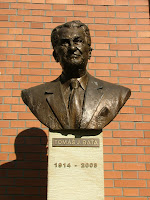 They're also connected with the story of one family and their company, Baťa Shoes. Siblings Anna, Antonín and Tomáš Baťa came from a long family line of cobblers but the company they founded in Zlín in 1894 became one of the biggest shoemaking concerns the world has ever seen and still has 50 factories, more than 4500 shops and almost 50,000 direct employees.
 There was an element of being in the right place at the right time for Baťa shoes (with the outbreak of World War One and huge orders from the Austrian army) but good management and integrity were key to the company's amazing expansion. Tomas Baťa was sometimes called the “Henry Ford of Eastern Europe” for his quickness to embrace the technologies of large-scale production, but he's best remembered in the history of Zlín for his integrity and social consciousness. Baťa employees were paid up to 4 times more than their counterparts in other countries and were assisted with housing, specialized training, medical care, insurance and retirement benefits decades (if not lifetimes) before before these things became the norm for factory workers elsewhere.The Baťa family left Czechoslovakia soon after the occupation by Nazi Germany, and in the late 1940s the remainder of Baťa shoes was nationalized by the new communist government. The communists tried to portray the Baťas as ruthless and exploitative capitalists, but such was the regard for the family that Jan Baťa was cleared of all 64 charges against him by an extraordinarily courageous jury. The communists came up with new charges, resorted to a closed military trial to justify the seizure of company assets and in 1949 Baťa shoes was renamed Svit, Zlín itself was renamed Gottwaldov (after the first Czech Communist president Klement Gottwald) and the Canadian province of Ontario became the new world home of Baťa shoes.
 Three places to find out more about the Zlín heyday of Baťa shoes are building 21 (the former headquarters), the excellent and extensive shoe museum, and street after street of the cute little Baťa villas - the cubelike houses built by the leading architects of the first republic for Baťa factory workers.
 The distinctive Baťa villas use the same combination of exposed red brick and pale grey concrete as the factories you'll see if you arrive at Zlín central station by train. Wandering the streets of villas and trying to imagine how wonderful they must have seemed to the factory workers of the 1920s and 30s is possible all year round, and from May through September the 1930s interior of the villa at Nad Ovčírnou II 1295 is also open to the public (unfortunately closed during 2011 'for technical reasons').
 The shoe museum takes its visitors through seven centuries of shoes ranging from peasant boots to embroidered royal slippers to a pair of 41cm monsters made for an American basketball player. There's also a recreated workshop and displays of techniques and tools. For non-Czech speakers there are translated booklets explaining all the exhibits, the history of shoemaking in general and the Baťa company specifically.
Building 21, the Zlín skyscraper, offers a wonderful view over the city from its new rooftop cafe and terrace, the chance to ride a continuous paternoster elevator and to visit the boss's office which was built in an 6x6m elevator (fitted with air-conditioning and running water) that could travel horizontally as well as vertically throughout the skyscraper! Unfortunately that was also closed on my last visit to Zlín, so I don't have any photos to show you, but the best way to remedy that is to plan a little trip to south Moravia and see it for yourself!
Tuesday, 22 November 2011
These boots are made for walkin'...

Tuesday, 8 November 2011
Between two churches...

Frýdek-Místek is a city of around 60,000 inhabitants that straddles the Ostravice river about 18km (11 miles) south of Ostrava. The river here forms the border between the old historic lands of Moravia and Silesia and the hyphen might be a clue that Frýdek-Místek was once two towns. Frýdek chateau sits atop a high rocky outcrop on the eastern, Silesian side of the river; Místek was founded to watch over the lower, western, Moravian side of the river crossing. The two tiny historic town centres of Frýdek and Místek are now surrounded by a sprawl of everything that was good and bad about the architecture and town planning of the socialist era. The high density apartment towers are separated by generous green spaces and the wide footpaths, tunnels and courtyards make it easy for pedestrians to get to either old town or the the bus and train stations that are just on the Frýdek side of the river. Unfortunately though, the lawns and gardens are unkempt, the pathways are crumbling and littered and the ground-floor shops that should have been grocery stores, hairdressers and newsagents have devolved into dark and mostly deserted non-stop bars filled with flashing lights and hypnotized gamblers.
Luckily there's more to Frýdek-Místek than its bedraggled suburbs and most visitors will probably spend their time in one or both of the historic old towns. The street layout of both is preserved. Místek is the smaller of the two and just off the tidy marketplace square stands the most impressive building. The church of St. James was originally Gothic but the striking red and white plaster and pear-shaped copper dome are from a later reconstruction in the baroque style. Many of the houses around the old marketplace square are quite attractive and one side has a beautiful long arcade walkway from the 1500's. There are some insensitive and ugly buildings on the square too, and because the old town of Místek is so small, you really only have to walk one block to be among the grimly oppressive pavilions that sell discount clothes and house a hard-to-comprehend number of seedy all-night gambling bars.
 Across the river in the shadow of the imposing Basilica of the Assumption of the Virgin Mary, Frýdek's old town does a better job of shrugging off the surrounding urban grimness. No doubt it's helped by its position atop a relatively steep-sided hill and the loosely connected ring of parks that cushion the impact of the communist-era architects. The imposing chateau that stands over the western end of Frýdek's slightly sloping rectangular square is open to the public six days a week and the courtyards and formal park are free of charge.
 The rest of the Frýdek square is lined by two, three and four storey townhouses in varying architectural styles, and they seem to house the best of the city's best cafes, restaurants, penzions and shops. My particular favourite is the Frýdek-Místek teahouse (at Hluboká 64).
 If you're not familiar with teahouses, they're inspired by the orient, offer 100 types of tea from across the world and there's at least one in every decent sized town in the Czech republic. I'm not sure what makes the Frýdek one so special but everyone I've taken there seems to agree it has a certain something. It's long been my favourite teahouse but if anyone thinks they've been to a better one, please post the address in the comments below because I'd love to check it out.
7
Tuesday, 18 October 2011
Hats off to Nový Jičín

 The main central square of Nový Jičín is one of the Czech Republic's most attractive. It's almost an equal-sided square and the two or three storey townhouses that line its edge have colourful facades and covered arcades that create an unbroken walkway around the entire perimeter. Not a single building looks out of place and towers of the town hall and the church of the holy trinity add an extra pinch of architectural drama.
 Two of the nicest houses on the square are both towards the corner near the Church of the Assumption. The yellow and white one with the balcony on each floor was originally the town's post office but is now used as shops, a cultural centre and on the top floor an excellent little cafe with seating inside or overlooking the square from the flower covered balcony. Nearby, the sky blue House of the White Angel has the most elaborately decorated of all the street frontages and has served as the town's pharmacy since the early 1700's.
 The plague column in the middle of the square has been recently restored and in front of it stands a small fountain with two dancing characters dressed in the typical German costume of the region. Nový Jičín was a Sudeten German town and if you meet ten locals, you'll probably hear ten different explanations for the figures on the fountain. If you meet the same guy that I met while I was crouching down to photograph it you might even hear a conspiracy theory or two.
 Away to one side of the plague column and the dancing German settlers is a new statue of St Nicholas gazing across towards the church tower. Near his feet lays a large bowl shaped fountain and surrounding it are three small sculptures of apples. I've no idea what they represent but they're cool. I also quite liked the modern coloured lights that play unobtrusively on some the historic buildings after dusk.
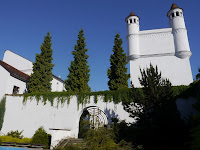 Just off the square the renaissance chateau houses the museum of hats and millinery. Nový Jičín has a centuries long tradition of hatmaking (since at least the early 1600's) including the opening of the TONAK workshops in 1799. Anyone with the slightest interest in vintage clothing absolutely must pay the museum a visit. Darling.
 With good transport links and good range of accommodation for all budgets, Nový Jičín is well worth considering as a base while you're exploring the countryside between Olomouc and Ostrava. Pretty little Štramberk is just a few kilometres away, as is Kopřivnice (and its Tatra automobile museum), Příbor (Sigmund Freud's home town) and the moody ruins of Starý Jičín castle.
Sunday, 10 April 2011
Another cycle trip
 If you meet an English speaking traveller who tells you they've done a week-long cycling tour in the Czech Republic, there's a pretty good chance (I'd guess at least 4 out of 5) that they rode either from Mikulov to Český Krumlov or from Český Krumlov to Mikulov. Which is fine, of course, but sometimes I answer questions on Lonely Planet's Thorn Tree forum and when one came up recently I found myself with hesitations about recommending the Mikulov-Krumlov shuffle.
South Moravia is probably my favourite region in the country and South Bohemia is definitely in the top three good-looking regions in the room, but I just wonder if this route really deserves four times as much attention and patronage as the rest of the cycle routes in the country put together. My main concern is that, with the exception of Znojmo, all the other towns might start to look a bit the same.
Znojmo has around 35000 inhabitants, medieval catacombs, and a variety of Romanesque, Gothic and Renaissance architecture; but Mikulov, Slavonice, Telč, Jindřichův Hradec, Třeboň and Český Krumlov are all smallish towns (maximum 20000 people) dominated by the renaissance architecture of the 16th century (two storeys plus attic, pastel or sgraffito facades, arcade walkways, and dating from 1500-1620). Unless you really have a specific interest in the variations and intricacies of Central European renaissance architecture (I must admit that applies to me) wouldn't this route be a bit like going to a smorgasbord dinner and having six helpings of the same dish? In the case of the fellow that asked the original question, (lets call him Ben) I kind of thought Mikulov to Krumlov would be OK, but he expressed interest in hearing any other suggestions I might have and because I'm intending to finish my round the country ride soon, I thought it might be a good exercise to plan an itinerary a bit and see if it's any use to him or anyone else.
Ben was thinking of beginning in Mikulov and my last ride finished in Mutěnice near Hodonín, but for the purposes of this we might split the difference and start in Břeclav. Ben has a week and I have more than a month, so he'd have to skip some of the things I'd visit and I'd be able to devote more time to each place.
Břeclav Břeclav is a good place to start because it has excellent rail connections and a well-equipped train station. Bombed in World War II, it's now a fairly unattractive town, but there is a chateau that was built to look like a partly ruined medieval castle during the romantic 19th century. Behind the chateau, cycle trail #43 heads off through the Dyje natural park towards Lednice chateau.
Lednice-Valtice area The Lednice-Valtice area is 2 square kilometres of landscaped countryside and world heritage architecture from the 19th century. The highlights are another mock ruined castle hunting lodge called Janův Hrad, the minaret designed by Josef Hardtmuth (better known abroad for his pencils), the Lednice chateau and greenhouse and the chateau and Jesuit church in Valtice. I've done this ride a few time and i like to follow trail 41 out of Lednice, then turn off along the lake to visit Hlohovec castle, which marks the old border between Moravia and Austria. From there it's up and over a vineyard-covered hill and down into Valtice. Valtice's wine cellars are a great opportunity to sample the local drop, but bear in mind that cyclists should technically have a 0.0 blood-alcohol-content. From Valtice there are minor country roads back to Břeclav or sandy trails through the forest and past the rendezvous and monuments.
Ruins of the Great Moravian Empire Trail #43 south out of Břeclav leads to Pohansko, which is marked on all the Lednice-Valtice maps because of the Pohansko chateau. More interesting to me though is the nearby archaeological site and reconstruction of a small encampment from the Great Moravian Empire. The Empire was the first organised nation state of Slavic peoples but you hear very little about it because most information comes out of Prague and getting a proud Praguer to use 'Great' and 'Moravia' in the same breath is like getting blood from a a stone.
Past Lanžhot, cycle trail 44 runs along the bank of the Morava river, and is a great opportunity to absorb what you learned at Pohansko, before delving into the centre of the great Moravian empire at Mikulčice. Actually no-one knows where the capital was, but the excavations at Mikulčice uncovered the largest cache of Great Moravian churches, graves, jewellery and ceramics ever found. It's likely to be the Czech Republic's next UNESCO-world heritage site.
Hodonín From there it's not far to Hodonín, which has an impressive main square church, and museums devoted to a) local boy and liberator president Tomas Garrigue Masaryk and b) South Moravia's oil industry. You didn't know they drilled for oil in South Moravia? Neither did I - I'm looking forward to visiting to find out more about it. From Hodonín, trail #47 leads along the river valley towards Strážnice, or we could shortcut through Slovakia and the pretty little town of Skalica.
Strážnice Strážnice is best known for the huge folk festival that takes place every year in and for its skansen. A skansen is basically an outdoor museum; in this case with a collection of typical traditional South Moravian cottages, farmhouses and gardens. There's also a renaissance chateau that offers budget accommodation, a Jewish cemetery and a small port for boats navigating the Bata Canal.
Uherské Hradiště or Uherský Brod & Luhačovice Uherské Hradiště is the biggest town in the Moravské Slovácko region. If it were possible to single out the one Czech region that has best held on to its folk traditions and customs it would probably be Moravské Slovácko. There's a handful of wonderful old historic buildings in Uherské Hradiště, but the best way to use the town is as a base to get into the real Slovácko countryside.
One good day long cycle trip is the loop to Buchlovice chateau ( home of the garlic festival) The imposing gothic Buchlov castle, Tupesy (ceramics workshop, gift centre and museum), Velehrad (pilgrimage church) and Modra (reconstructed huts, houses and church from the Great Moravian empire). Uherský Brod is a relaxed town with a couple of very impressive churches and a good museum to the most famous local boy Jan Amoš Komenský, better known abroad as Comenius - the teacher of nations. Luhačovice is a spa town in a lovely forested setting with some of architect Dušan Jurkovic's best work. Personally I think all places mentioned above are worth visiting, but a cyclist pressed for time would probably ride from Strážnice to Zlín either along the river via Uh. Hradiště or up over the hills via Uh. Brod and Luhačovice.
Zlín Home of Bata shoes. The innovative Bata factories, villas and shoe museum can all be visited and office block 21 is especially worthwhile for the rooftop terrace, the elevator office and the free exhibition on the eighth floor. The town chateau has good exhibition about the local film animation industry and the annual festival of children's film happens each year at the end of May.
Vallašské Meziříčí and Rožnov pod radhoštěm In my experience, Wallachia (Vallašsko) is the Czech republic's friendliest region. Vallašské Meziříčí is its biggest town and the pleasant old square, cool bars and cafes and the inexpensive guesthouse right in the chateau make it a good place to base yourself for a few days. Check out one of the teahouses and the coffee shop in the upholstery school.
 The big attraction of Rožnov pod radhoštěm is its collection of traditional wooden buildings. In the early 20th century there were two brothers who bought any timber building they heard was going to be demolished and somehow got permission to restore and reassemble them in the Rožnov town park on the right bank of the river Bečva. There's a church, a mill, a post office, a couple of working pubs and traditional festivals or events almost every weekend from May through September.
Nový Jičín/Štramberk/Kopřivnice/Příbor/Hukvaldy Nový Jičín and the towns nearby have plenty to keep anyone interested for few days. Nový Jičín has one of the prettiest main squares in the country, the hat museum and Starý Jičín castle ruins just outside town. Štramberk has good collection of traditional wooden Wallachian houses, the remains of a hilltop castle lookout tower and an excellent microbrewery on the main square. Příbor is Sigmund Freud's birthplace and the family house is now open to the public. Kopřivnice has the wonderfully quirky Tatra car and truck museum and Hukvaldy castle ruins are worth visiting even if you miss the annual Janaček music festival. The #502 trail connects most of these destinations.
Frýdek-Místek I want to go back to Frýdek-Místek mostly because it has the best teahouse I've ever been to. Frýdek and Místek were originally two towns; Místek on the left, Moravian bank of the Ostravice river, and Frýdek across on the opposite bank in Silesia. The historic centre of Frýdek around the square and chateau is lovely and I'm looking forward to exploring Místek too when I go back with a bicycle.
Český Těšín Český Těšín is the Czech part of the town that found itself split in two when a new international border between Czechoslovakia and Poland was drawn was drawn along the Olše river in 1920. Czech Těšín was cut off from the historic centre of town, and Polish Těšín lost the important rail connections that were on the western side of the river. Another upheaval came in 1938 when Polish troops annexed Czech Těšín after the Munich betrayal. These days you can just walk down and across the bridge into the neighbouring country and nobody bats an eyelid.
Havířov You wont find Havířov mentioned in many guidebooks but it seems like a very interesting place. It's an industrial city built in the early 1950s in the style of socialist realism. In those early years the communist party was still dominated by courageous people who joined when it was a persecuted organization and I'm keen to see if I can find differences in their architecture compared to the monstrosities of the 1970s when party membership was a prerequisite for every ambitious and unscrupulous citizen interested in personal power. Even if I'm wrong about the difference in architecture, I think the extensive collection of social-realist public sculpture will make the visit worthwhile.
Ostrava 3rd biggest city of the Czech republic and much-maligned as an ugly industrial sprawl populated by unemployed former miners. But ask anyone who has actually spent time there and the overwhelming response is that they really quite like it. The nightlife is famous but I also enjoyed the cafes, bookshops, the tour of the old steelworks and the museum of mining out in the northern suburbs. From Ostrava there are good train connections to all major cities in the region and Ben would probably finish here, while I'd like to push on to Opava, Krnov and the Jesenik mountains on my way home to Olomouc.
I've probably left this post a bit late to be useful to Ben, but I hope to cycle much of this route between about Mid may and Mid June this year. With tiny villages, towns and large industrial cities; everything from Great Moravian wooden cabins to social-realist reinforced concrete; forested hills, gentle flood plains; Moravian Slovak, Wallachian and Silesian culture and cuisine, it's going to be quite a trip.
Sunday, 20 June 2010
The marvels of Mikulov
Visitors interested in architecture and history will find few Czech towns with as much to offer as Mikulov in South Moravia. One of Moravia's four old Jewish towns, Mikulov is built on a limestone outcrop above the main road from Brno to Vienna just a couple of miles inside the Austrian border. For anyone who likes a drop or two of red to help their history and architecture go down, Mikulov is surrounded by one of Europe's most up and coming wine regions. At almost 2 hectares, Mikulov's Jewish cemetery is one of the largest in the country. The centuries of ivy-tangled gravestones include the final resting places of prominent Rabbis Menachem Mendel Krochmal, Shemuel Šmelke Horowitz, and Mordecai Benet. The cemetery's burial hall has emerged from long term reconstruction as an exhibition space and back in the Jewish quarter proper, the restored synagogue functions as a museum of Jewish history and culture from May through September.
 Behind the synagogue, a long staircase leads up to the hilltop perch of the four-winged chateau that greets visitors to Mikulov approaching along the north and south roads or the rail line from the east. The chateau is open to the public and displays the living quarters and other trappings of aristocratic life enjoyed by Mikulov's nobles, the Liechtenstein and then the Dietrichsteins.
 There's also an exhibit concerning Napoleon's 1805 stay in the chateau while he negotiated peace with the Austrians and the winemaking cellars hold lots of interesting historic equipment including an enormous wine barrel made in 1643 and with a capacity of 1010 hectalitres (that's enough for you and ninety-nine of your closest facebook friends to have a glass of wine with dinner every night for the next 13 years). The Mikulov chateau is a very impressive piece of architecture and I think most people would never guess it was rebuilt after being razed by the retreating German Army in 1945.
 On the opposite side of the chateau peak from the synagogue is the pretty town square. Tourist information and several wine bars are located on the square, as are at least three more of the town's valuable historic sites. The intricately decorated sgraffito house on the corner can be admired from the outside at any time of day or night, but the other two need to be visited to be properly appreciated.
 The belltower of the St. Wenceslas church is a dramatic addition to the Mikulov skyline, but for full effect it really needs to be climbed. The interior is also worth visiting but perhaps the most interesting corner of this church is tucked away behind a small iron door in the front facade. The crypt contains the bones of around 2000 people including members of the Dietrichstein and Lobkovice noble families.
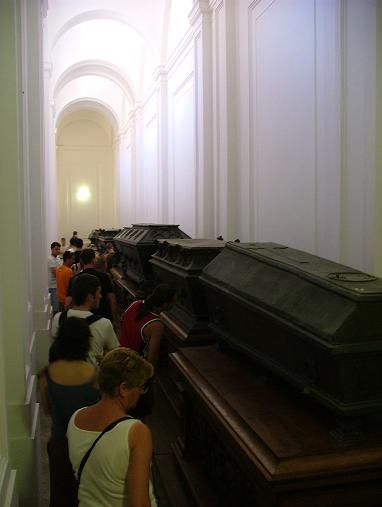 Most of the Dietrichsteins rest in the impressive building at the opposite side of the square. The former church of st Anne was rebuilt in 1844 to serve as a tomb for generations of the aristocratic Dietrichsteins. In the reconstruction, the fire damaged church was left roofless and the main nave became a courtyard for the new tomb. The side chapels were bricked in to form corridors and house 23 grand Dietrichstein coffins. The former choir of the church is now a rooftop terrace and is included in the guided tour of the tomb.
 From the terrace there are views across the pretty main square to the chateau and the church and on a hilltop across to the right are the ruins of the Goats' Castle (Kozi hradek). The Czech word Hradek indicates that it was only a very small castle, but the ruins are interesting to clamber around and the views back across town are ample reward for the uphill slog through the streets and lanes near the Jewish cemetery. If a little liquid reward is also necessary there's a good summer refreshment stand in a clearing at the top.
 The other rewarding Mikulov hill climb is up behind the Dietrichstein tomb. The blue-marked path up the side of Svatý Kopeček (Holy Hill) is lined with small chapels that represent the 12 stations of the cross and at the peak is the pilgrimage chapel of St. Sebastian. The wide views across Mikulov and the surrounding hills and plains extend into Austria and the hilltop castles that guarded that side of the border.
With so much to see and do, and Mikulov's 8000 or so inhabitants typically blessed with the sunny South Moravian disposition, it's a place that deserves consideration for all but the skimpiest of Czech Republic itineraries.
Related posts:
Daytrips from Brno
Bone churches of Bohemia and Moravia
Accomodation:
Mikulov hotels
Mikulov hostels
Transport:
Bus and Train connections to Mikulov
Wednesday, 9 June 2010
A history book in your wallet
 Czech history may seem obtuse to travellers when they first arrive from abroad, but a shortcut to understanding it may be as close as your hip pocket. The beautifully designed series of Czech banknotes depict prominent figures from the country's history in a neat progression from the 12th to 20th centuries.
 20Kč Přemysl Otakar I (1166-1230)
The old 20Kč notes have largely been replaced by coins now, which is a pity because it's one of the nicest designs. The diplomatic skills of Přemysl Otakar I brought about an era of relative peace within the volatile ruling classes of the Czech lands. Under his reign, the Bohemian crown became recognised as hereditary by the Pope, the Holy Roman Emperor and other European powers and 20Kč note therefore represents the beginnings of the Bohemian kingdom as a stable political entity. Přemysl Otakar I is buried in Prague's St Vitus' cathedral. 50Kč Saint Agnes of Bohemia (1211-1282)
As youngest daughter of Přemysl Otakar I, Agnes was born into a life of wealth, comfort and influence. After several arranged and broken engagements, one of which led to a war, (English King Henry III and Holy Roman Emperor Frederick II were among her suitors) Agnes retreated from aristocratic life, took vows of poverty and chastity and spent her adult life performing religious works. The convent she founded on the right bank of the Vltava river is one of Bohemia's earliest Gothic buildings and the rear of the banknote shows a view towards the ribs and arches of its ceiling. Her canonization by Pope John Paul II preceded by five days the Velvet Revolution of 1989. 100Kč King Charles IV (1316-1378)
Charles IV is considered by many to have been the greatest King of Bohemian history. Charles's mother was Saint Agnes' niece Eliška Přemyslovna and his father was King John of Luxembourg. The benefits and perspective of Charles' education at the French court combined with his deep faith and affection for Bohemia to bring a golden age of development to Prague. Rather than moving to take up his post when crowned Holy Roman Emperor, Charles made the empire come to him and declared Prague the new capital. Surviving monuments of the time include the Přemyslid tomb in St Vitus' cathedral, the celebrated Charles' Bridge and Karlštejn castle. Elements of Gothic architecture decorate both sides of the 100Kč banknote. 200Kč Jan Amoš Komenský (1592-1670)
Born in on near Uherský Brod in 1592, Jan Amoš Komenský attended the Latin school in Přerov and became a pastor as central Europe lurched towards the Thirty Year's War. During his studies Komenský adopted protestant ideals and was forced into exile by the persecution that followed Catholic victory in 1620. Komenský's writings on universal practical education brought widespread renown and he was invited to work in the great countries of Europe including Hungary, Sweden, England and the Netherlands. He was also the last bishop of the exiled Unity of Brethren which fragmented and reformed as the Moravian Church, popular in parts of the United States. Komenský is better known abroad under his Latin name Comenius and is widely considered to be the father of modern education. He's buried in Naarden in the Netherlands. 500Kč Božena Němcová (1820-1862)
The period from the thirty years war to the mid-19th century was a dark time in Czech history. Ruled by the Hapsburg dynasty from Vienna, Czech language and culture were at best neglected, at worst actively suppressed. The revolutionary events of 1848 encouraged the Hapsburg court to flee Vienna for Olomouc, where Emperor Ferdinand was persuaded to abdicate in favour of his nephew, the liberal and far-sighted Franz Joseph. The resulting easing of restrictions on ethnic minorities within the empire brought about a period of freedom that Czechs know as the National Revival. Božena Němcová became one of the leading writers of the period and is most closely associated with the 'Grandmother's valley' area around Ratibořice and České Skalice in North-East Bohemia, where her best known semi-autobiographical works are set. 1000Kč František Palacký (1798-1876)
Also active at the time of the Czech National Revival after 300 years of Austrian Imperial rule, Frantisek Palacký was a historian and politician whose 5-volumed 'History of the Czech Nation in Bohemia and Moravia' offered modern Czechs the first account of their own history from their own perspective in their own language. Alongside Charles IV and Masaryk, Palacký is considered one of the fathers of the Czech Nation (Otec narodů) and many city squares, boulevards and even the country's second university are named in his honour. He was born and grew up in Hodslavice in North Moravia and is buried at Lobkovice which is now part of Neratovice near Mělník. 2000Kč Emmy Destinn (1878-1930)
Emmy Destinn was a Prague-born opera singer who earned international fame for her roles in Strauss, Puccini and Wagner operas. She appeared frequently opposite Enrico Caruso in the opera houses of New York, London and Berlin, but her career declined with the coming of WWI. She was publicly linked with the patriotic Czech resistance and confined to the chateau at Stráž nad Nežarkou in South Bohemia until the war ended. The banknote design suggests the art nouveau movement popular during Emmy Destinn's life and is my favourite of the series. 5000Kč Tomáš Garrigue Masaryk (1850-1937)
Most visitors to the Czech Republic won't see many 5000Kč notes featuring TGM in daily circulation, but that's OK because in every Czech town or city there's at least one statue or a square, avenue, embankment, college or university named in his memory. Masaryk served in the Austrian Parliament as a member of the Young Czech Party but when WWI broke out he went into exile and began agitating for an independent Czech and Slovak state. When the Austrian Empire fell, the Allies recognized Masaryk as leader of a caretaker government. In the first elections he was voted President of Czechoslovakia and served until 1935. Born in Hodonín on the border of Moravia and Slovakia, Masaryk passed away at the age of 87 and rests now in the grounds of the presidential chateau at Lány in Central Bohemia.
The 20Kč note is rare and there's now a 50Kč coin so perhaps Agnes' days are numbered too. The rest of the gang seem safe until at least 2014, which is the earliest realistic date for the adoption of the common European currency.
Related posts: When Czech Republic adopts the Euro...


