
 In the context of Czech towns and cities that might be interesting to foreign travellers, Zlín is quite unusual because most of its tourist attractions are modern.
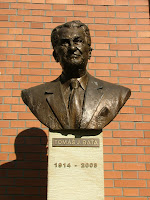 They're also connected with the story of one family and their company, Baťa Shoes. Siblings Anna, Antonín and Tomáš Baťa came from a long family line of cobblers but the company they founded in Zlín in 1894 became one of the biggest shoemaking concerns the world has ever seen and still has 50 factories, more than 4500 shops and almost 50,000 direct employees.
 There was an element of being in the right place at the right time for Baťa shoes (with the outbreak of World War One and huge orders from the Austrian army) but good management and integrity were key to the company's amazing expansion. Tomas Baťa was sometimes called the “Henry Ford of Eastern Europe” for his quickness to embrace the technologies of large-scale production, but he's best remembered in the history of Zlín for his integrity and social consciousness. Baťa employees were paid up to 4 times more than their counterparts in other countries and were assisted with housing, specialized training, medical care, insurance and retirement benefits decades (if not lifetimes) before before these things became the norm for factory workers elsewhere.The Baťa family left Czechoslovakia soon after the occupation by Nazi Germany, and in the late 1940s the remainder of Baťa shoes was nationalized by the new communist government. The communists tried to portray the Baťas as ruthless and exploitative capitalists, but such was the regard for the family that Jan Baťa was cleared of all 64 charges against him by an extraordinarily courageous jury. The communists came up with new charges, resorted to a closed military trial to justify the seizure of company assets and in 1949 Baťa shoes was renamed Svit, Zlín itself was renamed Gottwaldov (after the first Czech Communist president Klement Gottwald) and the Canadian province of Ontario became the new world home of Baťa shoes.
 Three places to find out more about the Zlín heyday of Baťa shoes are building 21 (the former headquarters), the excellent and extensive shoe museum, and street after street of the cute little Baťa villas - the cubelike houses built by the leading architects of the first republic for Baťa factory workers.
 The distinctive Baťa villas use the same combination of exposed red brick and pale grey concrete as the factories you'll see if you arrive at Zlín central station by train. Wandering the streets of villas and trying to imagine how wonderful they must have seemed to the factory workers of the 1920s and 30s is possible all year round, and from May through September the 1930s interior of the villa at Nad Ovčírnou II 1295 is also open to the public (unfortunately closed during 2011 'for technical reasons').
 The shoe museum takes its visitors through seven centuries of shoes ranging from peasant boots to embroidered royal slippers to a pair of 41cm monsters made for an American basketball player. There's also a recreated workshop and displays of techniques and tools. For non-Czech speakers there are translated booklets explaining all the exhibits, the history of shoemaking in general and the Baťa company specifically.
Building 21, the Zlín skyscraper, offers a wonderful view over the city from its new rooftop cafe and terrace, the chance to ride a continuous paternoster elevator and to visit the boss's office which was built in an 6x6m elevator (fitted with air-conditioning and running water) that could travel horizontally as well as vertically throughout the skyscraper! Unfortunately that was also closed on my last visit to Zlín, so I don't have any photos to show you, but the best way to remedy that is to plan a little trip to south Moravia and see it for yourself!
Tuesday, 22 November 2011
These boots are made for walkin'...

Thursday, 17 November 2011
Grandmother's Valley
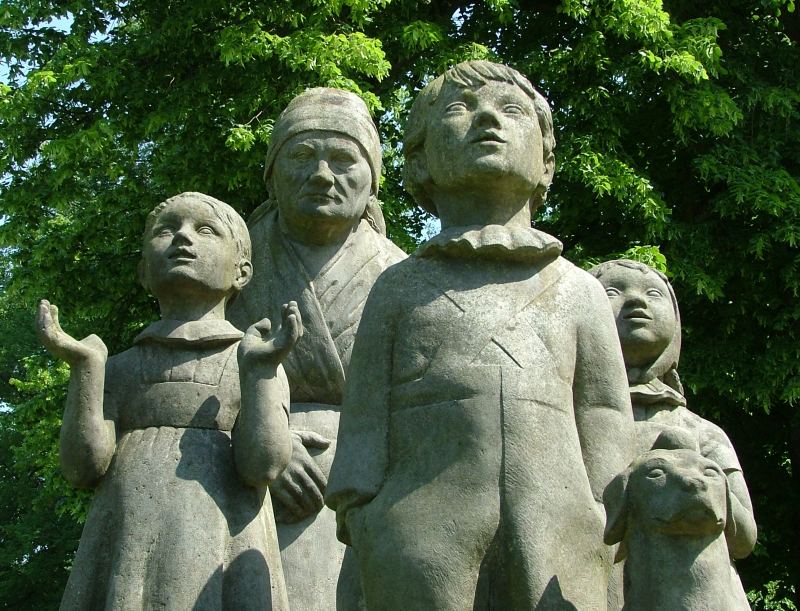
"It was long, long ago, when last I gazed on that dear face, kissed those pale, wrinkled cheeks, and tried to fathom the depths of those blue eyes, in which were hidden so much goodness and love." The author of this simple lament for her deceased grandmother was one of Czech literature's most highly regarded figures, Božena Němcová. Her image graces the five hundred crown banknote, and the cool, green valley of the Úpa river around the Ratibořice chateau is called Grandmother's valley after her most beloved character. Grandmother is an iconic story in Romantic Czech literature and if you think of the regard for stories like Huckleberry Finn or the Adventures of Robin Hood you’ll have an idea of the tale's place in the national consciousness.
 For anyone who has read Grandmother and wants to find out more, the gentle, leafy stretch of the Úpa river valley from Havlovice to Česká Skalice is a good place to start. Božena's father worked as a stablehand at the Ratibořice chateau for most of her childhood and it along with the other prominent buildings of the valley provide the setting for her stories.
 The Ratibořice chateau sits on the side of a low hill surrounded by dense gardens. As you crossed the Úpa River and follow the road across its open floodplain, the trees of the forest provide an almost theatrical backdrop. As you draw close to the chateau around the gentle right hand bend, the huge carpark and the jumble of souvenir and refreshment stands will make immediately clear just how popular this place is among individuals and school groups.
 A little further along the same road is the old water mill. The narrow channel that runs alongside still turns the huge wooden waterwheels, but the roguish miller and his family are long gone. Further up the valley again near a weir is the wide flat plain called bělidlo, which come from the word běla or bíla meaning white. Usually translated into English as the Bleachery, it was the place that the peasants of the valley gathered to wash their linen and clothes and spread them out on the even grass to dry in the sunshine. The wooden cottage there was Božena's childhood home.
 When you've explored the chateau, the mill and the cottage at the old bleachery, there's also a very pretty 3km path along which young Božena walked from Ratibořice to attend school in Česká Skalice. The path is marked with signs describing the history but they’re only in Czech. The Božena Němcová museum in Česká Skalice's old wooden schoolhouse has translations for the exhibits.
 Even if you won't make it to Grandmothers valley, take a look at Božena's portrait on the five hundred crown banknote and keep an eye out for statues of her or streets named in her honour. She's an important and respected figure in modern Czech history and if you're spending much time in the Czech Republic it's good to be aware of at least a couple of those.
Tuesday, 8 November 2011
Between two churches...

Frýdek-Místek is a city of around 60,000 inhabitants that straddles the Ostravice river about 18km (11 miles) south of Ostrava. The river here forms the border between the old historic lands of Moravia and Silesia and the hyphen might be a clue that Frýdek-Místek was once two towns. Frýdek chateau sits atop a high rocky outcrop on the eastern, Silesian side of the river; Místek was founded to watch over the lower, western, Moravian side of the river crossing. The two tiny historic town centres of Frýdek and Místek are now surrounded by a sprawl of everything that was good and bad about the architecture and town planning of the socialist era. The high density apartment towers are separated by generous green spaces and the wide footpaths, tunnels and courtyards make it easy for pedestrians to get to either old town or the the bus and train stations that are just on the Frýdek side of the river. Unfortunately though, the lawns and gardens are unkempt, the pathways are crumbling and littered and the ground-floor shops that should have been grocery stores, hairdressers and newsagents have devolved into dark and mostly deserted non-stop bars filled with flashing lights and hypnotized gamblers.
Luckily there's more to Frýdek-Místek than its bedraggled suburbs and most visitors will probably spend their time in one or both of the historic old towns. The street layout of both is preserved. Místek is the smaller of the two and just off the tidy marketplace square stands the most impressive building. The church of St. James was originally Gothic but the striking red and white plaster and pear-shaped copper dome are from a later reconstruction in the baroque style. Many of the houses around the old marketplace square are quite attractive and one side has a beautiful long arcade walkway from the 1500's. There are some insensitive and ugly buildings on the square too, and because the old town of Místek is so small, you really only have to walk one block to be among the grimly oppressive pavilions that sell discount clothes and house a hard-to-comprehend number of seedy all-night gambling bars.
 Across the river in the shadow of the imposing Basilica of the Assumption of the Virgin Mary, Frýdek's old town does a better job of shrugging off the surrounding urban grimness. No doubt it's helped by its position atop a relatively steep-sided hill and the loosely connected ring of parks that cushion the impact of the communist-era architects. The imposing chateau that stands over the western end of Frýdek's slightly sloping rectangular square is open to the public six days a week and the courtyards and formal park are free of charge.
 The rest of the Frýdek square is lined by two, three and four storey townhouses in varying architectural styles, and they seem to house the best of the city's best cafes, restaurants, penzions and shops. My particular favourite is the Frýdek-Místek teahouse (at Hluboká 64).
 If you're not familiar with teahouses, they're inspired by the orient, offer 100 types of tea from across the world and there's at least one in every decent sized town in the Czech republic. I'm not sure what makes the Frýdek one so special but everyone I've taken there seems to agree it has a certain something. It's long been my favourite teahouse but if anyone thinks they've been to a better one, please post the address in the comments below because I'd love to check it out.
7
Tuesday, 11 October 2011
Trying to like Ústí

Among the rounded hills of the North Bohemian highlands about 80km north of Prague, the city of Ústí nad Labem lies in the valley of the mighty Labe River where the smaller river Bílina joins it on the long journey towards the North Sea. It may sound like a lovely setting for a city, but Ústí has a reputation as being not a very nice place to visit. And as you approach, it’s easy to see why. No matter from the north or south or by train from the west along the Bílina valley, huge industrial and manufacturing zones litter the skyline, hillsides and riverbanks with smoke stacks, silos, conveyor belts and docking cranes.
 Poor Ústí can’t even rely on the saving grace of many riverside cities, their bridges, for a bit of architectural interest or romance. The southernmost of Ústí’s three river crossings is a flat Meccano-like span and the middle bridge with the arched top is little better. Despite its brutal modern design, the northernmost bridge is the most striking of the three. Two high sharp-edged pillars of reinforced concrete rise asymmetrically from the river’s eastern bank and from those, steel cables as thick as a man’s leg fan out to evenly spaced points across the span like the web of a monstrous mechanical spider or one of those string and pin wall hangings your crafty aunt used to make back in the 1970’s.
The old centre of Ústí roughly keeps the original layout of the customs settlement that grew beside the river between the 10th and 13th centuries, but apart from the two churches, there’s little remaining of historic architectural interest. On the main square alone there are five modern buildings of six stories or more. Of them the only one that really displays any architectural grace is the Česká Spořitelna building with its considered proportions and detailed relief work around the entrances. There’s also an interesting mosaic column, presumably from the communist era, that scales the height of the bronze-windowed Magistrát Města building, but when I visited in October 2008 it appeared soon to disappear behind whatever the cranes and concrete trucks were constructing behind the barricades in that corner of the square.
The worst of the buildings is the 13 storey bright blue Interhotel Bohemia. As if being 13 floors high and bright but grimy blue weren’t enough, it also has large illuminated signs proclaiming Casino Non-stop and a flashing and beeping electronic billboard that blasts out across the main part of the square.
With so many Czech cities and towns talking such good care of their historic centres, how did Ústí manage to become such an eyesore? Grim European cities tend to fall into one of two categories; industrial or war-damaged. Ústí falls into both.
When the industrial revolution began to replace traditional manual labour with machines and factories in the 18th and 19th centuries, Ústí found itself with all the prerequisites for transformation into an industrial and manufacturing centre; The surrounding hills are laced with rich deposits of brown coal which was a convenient source of energy and the wide and easily navigable river Labe at its feet provided Ústí with an efficient means of transport. Two large ports were built on the left bank of the Labe, a shipbuilding factory soon followed and not only did Ústí mine and ship coal, coal powered factories were built nearby to manufacture goods close to the source of their energy.
Today the Setuza industrial area is the backdrop for any view across the river from the centre of Ústí and slightly west of the centre along the valley of the Bílina River, is another industrial area the size of a small city. The main resident here is Spolchemie a.s. They manufacture chemicals, glues and other substances for use in the building, plastics and pharmaceutical industries.
On top of 100 gloomy years of coal mining and heavy industry, Ústí suffered more than most Czech cities during the Nazi occupation from 1938-45. In the mid 1930’s there had been a sizable Jewish community in Ústí nad Labem including prominent business families the Petscheks and the Weinmanns. Both families managed to emigrate before Ústí was, along with the rest of the Sudetenland, fell into Mr Hitler’s control in October 1938. The Petschek villa was occupied by the Gestapo then the Communist Party and is now an art school. Ústí’s Jewish quarter just west of the city centre was completely destroyed during the war and the land is now part of the Spolchemie industrial zone. No trace remains of The Ústí synagogue, which was burnt to the ground at the end of 1938 and the former hillside Jewish cemetery is now the city park. The headstones that couldn’t be sold or otherwise used were laid flat and covered with earth and there they remain, the Cemetery remembered only by a monument in the form of a huge stone Star of David half buried in the soil at the lowest corner of the park.
The worst blows to Ústí came towards the end of WWII. A section of the Berlin to Prague Railway had been laid through in the 1870’s and with its high-capacity ports Ústí was one of the busiest and most important transport hubs in central Europe. With the German Army transporting huge numbers of troops through Ústí and making use of the extensive manufacturing hardware to produce arms it was an obvious target for Allied bombing raids.
The allies first bombed Ústí in December 1944, but the most destructive raids were in April the following year. In two raids, the 8th squadron of the American air force destroying almost a quarter of the city’s buildings. Both historic churches were damaged and at least 512 people lost their lives. The majority of the German troops managed to survive the bombing in air raid shelters; most of the known victims were local residents, German civilians retreating before the approaching eastern front, or prisoners of war including French, Czech and Slovakian resistance fighters and captive soldiers of the soviet red army. Especially tragic was that for those 512 lives and 2137 buildings destroyed, the Allied forces gained almost nothing. The Wehrmacht was able to repair the railway junction to resume full transport of troops and supplies to the eastern front through Ústí within a matter of hours, and the manufacture of weapons and ammunition was unaffected.
Tragically the bombing raids weren’t the only unnecessary mass loss of innocent lives in Ústí that year. Czechoslovakia’s ethnic German minority was Hitler’s main excuse for his invasion, and many of those ‘liberated’ Sudeten Germans enthusiastically became enthusiastic Nazi supporters and collaborators.
Immediately following the war, the understandably anti-German feeling in Czech society, and the gradual revelation of the full scale of the crimes of the holocaust made it seem impossible that the two nationalities could ever again live peacefully side by side in a single society. The transfer of ethnic Germans to Germany and Austria seemed the only conceivable solution and was approved by the Allied powers at the Potsdam conference in August 1945.Before the officially approved population transfer began though were a series of events collectively known as the wild expulsion. Groups of armed Czechs took the law into their own hands and violently forced their German neighbours from their homes, towns and the country. The worst incidents were the Brno death march and the massacres at Postoloprty, Švédská Šance (near Přerov) and Ústí nad Labem.
On the afternoon of 31 June 1945 a group of ethnic Germans finished work at the Setuza factory (from Severočeské Tukové Závody-the elegantly named North Bohemian Fat Works) in Ústí nad Labem, and set out to walk home across the middle of Ústí’s three bridges. They met a group of Czechs, words were exchanged and it led to a violent struggle in which as many as 100 of the Germans were thrown from the bridge and lost their lives in the waters of the Labe River below. The custodian of the Ústí museum who first told me the story said that even children and babies in prams were thrown to their deaths. The Ústí massacre is not a very well known event and seems to have been so thoroughly covered up during the communist era that many Czechs have never heard of it. If you’re ever in Ústí though, take a walk across the bridge on the downstream footpath and out near the middle you'll find a small plaque with the words “In memory of the victims of the violence on 31.7.1945”.
As you lean over the railing and think about the distance to the water’s surface, spare a moment to be grateful that the human race has matured and progressed to the point that mob violence based on a victim’s ethnicity couldn't...uh, never mind.
Sunday, 20 June 2010
The marvels of Mikulov
Visitors interested in architecture and history will find few Czech towns with as much to offer as Mikulov in South Moravia. One of Moravia's four old Jewish towns, Mikulov is built on a limestone outcrop above the main road from Brno to Vienna just a couple of miles inside the Austrian border. For anyone who likes a drop or two of red to help their history and architecture go down, Mikulov is surrounded by one of Europe's most up and coming wine regions. At almost 2 hectares, Mikulov's Jewish cemetery is one of the largest in the country. The centuries of ivy-tangled gravestones include the final resting places of prominent Rabbis Menachem Mendel Krochmal, Shemuel Šmelke Horowitz, and Mordecai Benet. The cemetery's burial hall has emerged from long term reconstruction as an exhibition space and back in the Jewish quarter proper, the restored synagogue functions as a museum of Jewish history and culture from May through September.
 Behind the synagogue, a long staircase leads up to the hilltop perch of the four-winged chateau that greets visitors to Mikulov approaching along the north and south roads or the rail line from the east. The chateau is open to the public and displays the living quarters and other trappings of aristocratic life enjoyed by Mikulov's nobles, the Liechtenstein and then the Dietrichsteins.
 There's also an exhibit concerning Napoleon's 1805 stay in the chateau while he negotiated peace with the Austrians and the winemaking cellars hold lots of interesting historic equipment including an enormous wine barrel made in 1643 and with a capacity of 1010 hectalitres (that's enough for you and ninety-nine of your closest facebook friends to have a glass of wine with dinner every night for the next 13 years). The Mikulov chateau is a very impressive piece of architecture and I think most people would never guess it was rebuilt after being razed by the retreating German Army in 1945.
 On the opposite side of the chateau peak from the synagogue is the pretty town square. Tourist information and several wine bars are located on the square, as are at least three more of the town's valuable historic sites. The intricately decorated sgraffito house on the corner can be admired from the outside at any time of day or night, but the other two need to be visited to be properly appreciated.
 The belltower of the St. Wenceslas church is a dramatic addition to the Mikulov skyline, but for full effect it really needs to be climbed. The interior is also worth visiting but perhaps the most interesting corner of this church is tucked away behind a small iron door in the front facade. The crypt contains the bones of around 2000 people including members of the Dietrichstein and Lobkovice noble families.
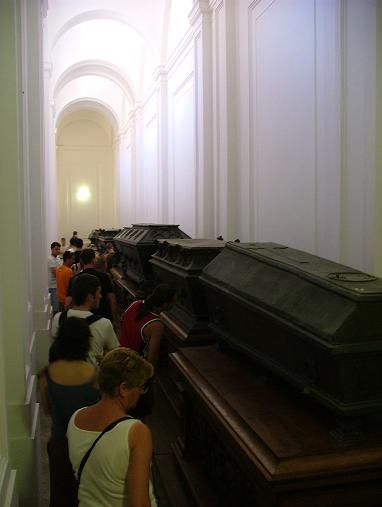 Most of the Dietrichsteins rest in the impressive building at the opposite side of the square. The former church of st Anne was rebuilt in 1844 to serve as a tomb for generations of the aristocratic Dietrichsteins. In the reconstruction, the fire damaged church was left roofless and the main nave became a courtyard for the new tomb. The side chapels were bricked in to form corridors and house 23 grand Dietrichstein coffins. The former choir of the church is now a rooftop terrace and is included in the guided tour of the tomb.
 From the terrace there are views across the pretty main square to the chateau and the church and on a hilltop across to the right are the ruins of the Goats' Castle (Kozi hradek). The Czech word Hradek indicates that it was only a very small castle, but the ruins are interesting to clamber around and the views back across town are ample reward for the uphill slog through the streets and lanes near the Jewish cemetery. If a little liquid reward is also necessary there's a good summer refreshment stand in a clearing at the top.
 The other rewarding Mikulov hill climb is up behind the Dietrichstein tomb. The blue-marked path up the side of Svatý Kopeček (Holy Hill) is lined with small chapels that represent the 12 stations of the cross and at the peak is the pilgrimage chapel of St. Sebastian. The wide views across Mikulov and the surrounding hills and plains extend into Austria and the hilltop castles that guarded that side of the border.
With so much to see and do, and Mikulov's 8000 or so inhabitants typically blessed with the sunny South Moravian disposition, it's a place that deserves consideration for all but the skimpiest of Czech Republic itineraries.
Related posts:
Daytrips from Brno
Bone churches of Bohemia and Moravia
Accomodation:
Mikulov hotels
Mikulov hostels
Transport:
Bus and Train connections to Mikulov
Wednesday, 9 June 2010
A history book in your wallet
 Czech history may seem obtuse to travellers when they first arrive from abroad, but a shortcut to understanding it may be as close as your hip pocket. The beautifully designed series of Czech banknotes depict prominent figures from the country's history in a neat progression from the 12th to 20th centuries.
 20Kč Přemysl Otakar I (1166-1230)
The old 20Kč notes have largely been replaced by coins now, which is a pity because it's one of the nicest designs. The diplomatic skills of Přemysl Otakar I brought about an era of relative peace within the volatile ruling classes of the Czech lands. Under his reign, the Bohemian crown became recognised as hereditary by the Pope, the Holy Roman Emperor and other European powers and 20Kč note therefore represents the beginnings of the Bohemian kingdom as a stable political entity. Přemysl Otakar I is buried in Prague's St Vitus' cathedral. 50Kč Saint Agnes of Bohemia (1211-1282)
As youngest daughter of Přemysl Otakar I, Agnes was born into a life of wealth, comfort and influence. After several arranged and broken engagements, one of which led to a war, (English King Henry III and Holy Roman Emperor Frederick II were among her suitors) Agnes retreated from aristocratic life, took vows of poverty and chastity and spent her adult life performing religious works. The convent she founded on the right bank of the Vltava river is one of Bohemia's earliest Gothic buildings and the rear of the banknote shows a view towards the ribs and arches of its ceiling. Her canonization by Pope John Paul II preceded by five days the Velvet Revolution of 1989. 100Kč King Charles IV (1316-1378)
Charles IV is considered by many to have been the greatest King of Bohemian history. Charles's mother was Saint Agnes' niece Eliška Přemyslovna and his father was King John of Luxembourg. The benefits and perspective of Charles' education at the French court combined with his deep faith and affection for Bohemia to bring a golden age of development to Prague. Rather than moving to take up his post when crowned Holy Roman Emperor, Charles made the empire come to him and declared Prague the new capital. Surviving monuments of the time include the Přemyslid tomb in St Vitus' cathedral, the celebrated Charles' Bridge and Karlštejn castle. Elements of Gothic architecture decorate both sides of the 100Kč banknote. 200Kč Jan Amoš Komenský (1592-1670)
Born in on near Uherský Brod in 1592, Jan Amoš Komenský attended the Latin school in Přerov and became a pastor as central Europe lurched towards the Thirty Year's War. During his studies Komenský adopted protestant ideals and was forced into exile by the persecution that followed Catholic victory in 1620. Komenský's writings on universal practical education brought widespread renown and he was invited to work in the great countries of Europe including Hungary, Sweden, England and the Netherlands. He was also the last bishop of the exiled Unity of Brethren which fragmented and reformed as the Moravian Church, popular in parts of the United States. Komenský is better known abroad under his Latin name Comenius and is widely considered to be the father of modern education. He's buried in Naarden in the Netherlands. 500Kč Božena Němcová (1820-1862)
The period from the thirty years war to the mid-19th century was a dark time in Czech history. Ruled by the Hapsburg dynasty from Vienna, Czech language and culture were at best neglected, at worst actively suppressed. The revolutionary events of 1848 encouraged the Hapsburg court to flee Vienna for Olomouc, where Emperor Ferdinand was persuaded to abdicate in favour of his nephew, the liberal and far-sighted Franz Joseph. The resulting easing of restrictions on ethnic minorities within the empire brought about a period of freedom that Czechs know as the National Revival. Božena Němcová became one of the leading writers of the period and is most closely associated with the 'Grandmother's valley' area around Ratibořice and České Skalice in North-East Bohemia, where her best known semi-autobiographical works are set. 1000Kč František Palacký (1798-1876)
Also active at the time of the Czech National Revival after 300 years of Austrian Imperial rule, Frantisek Palacký was a historian and politician whose 5-volumed 'History of the Czech Nation in Bohemia and Moravia' offered modern Czechs the first account of their own history from their own perspective in their own language. Alongside Charles IV and Masaryk, Palacký is considered one of the fathers of the Czech Nation (Otec narodů) and many city squares, boulevards and even the country's second university are named in his honour. He was born and grew up in Hodslavice in North Moravia and is buried at Lobkovice which is now part of Neratovice near Mělník. 2000Kč Emmy Destinn (1878-1930)
Emmy Destinn was a Prague-born opera singer who earned international fame for her roles in Strauss, Puccini and Wagner operas. She appeared frequently opposite Enrico Caruso in the opera houses of New York, London and Berlin, but her career declined with the coming of WWI. She was publicly linked with the patriotic Czech resistance and confined to the chateau at Stráž nad Nežarkou in South Bohemia until the war ended. The banknote design suggests the art nouveau movement popular during Emmy Destinn's life and is my favourite of the series. 5000Kč Tomáš Garrigue Masaryk (1850-1937)
Most visitors to the Czech Republic won't see many 5000Kč notes featuring TGM in daily circulation, but that's OK because in every Czech town or city there's at least one statue or a square, avenue, embankment, college or university named in his memory. Masaryk served in the Austrian Parliament as a member of the Young Czech Party but when WWI broke out he went into exile and began agitating for an independent Czech and Slovak state. When the Austrian Empire fell, the Allies recognized Masaryk as leader of a caretaker government. In the first elections he was voted President of Czechoslovakia and served until 1935. Born in Hodonín on the border of Moravia and Slovakia, Masaryk passed away at the age of 87 and rests now in the grounds of the presidential chateau at Lány in Central Bohemia.
The 20Kč note is rare and there's now a 50Kč coin so perhaps Agnes' days are numbered too. The rest of the gang seem safe until at least 2014, which is the earliest realistic date for the adoption of the common European currency.
Related posts: When Czech Republic adopts the Euro...
Monday, 31 May 2010
Cold war nuclear bomb shelter
A toadstool of reinforced concrete growing at the base of the Bezruč gardens city walls conceals the entrance to Olomouc's newest historic attraction. The civil defence shelter was built from 1953 to 1956 to house the city's leaders in the event of a chemical or nuclear attack from Western Europe. Because it was meant for leaders, the shelter was a particularly elaborate and well equipped version of the bunkers that ordinary citizens remember from regular safety drills throughout their school and working lives.
Entry is possible only in the presence of a guide and the visiting times are 10.00, 13.00 and 16.00 on Saturdays and 14.00 on Thursdays from mid May to mid September. There's a minimum of 3 and a maximum of 20 participants on each tour and the admission charge is a symbolic 20Kč. Tickets are available and the tour begins from the tourist information office on the main square. The walk down into the park behind St Michael's takes about 5 minutes and it may take another five minutes for the guide to open the heavy steel doors that were the first line of defence against nuclear, chemical or conventional attack.
Once inside the bunker, the guide talks about the design of the entrance in particular and the four skins of the bunker overall. The bunker is largely steel-reinforced concrete, but one of the four layers is of soft earth, which was intended to act as a cushion against the impact of any near-direct explosion.
The first rooms inside the entrance are the decontamination showers and from there the corridors lead past rooms containing all the practicalities necessary for 82 people to survive 72 hours. Pumps, a deep well, a watertank, compressors, a complicated arrangement of airfilters and ducts, and a diesel powered oxygen generator are maintained in working order in their rooms off to the left of the corridor.
F urther on are the telephone and radio rooms and in the heart of the bunker is the situation room, which would been furnished with tables and chairs, maps and a full width chalkboard. Unfortunately most of the furnishings and equipment from these rooms was lost in the years immediately after the fall of communism when the neglected shelter was used by homeless people on cold winter nights.
 After the situation room and the radiation testing room the tour loops back towards the entrance and ascends to the upper floor, which was the living quarters. Around the edge of the bunker are the toilets, showers, kitchen and dining rooms and in the centre above the situation room are the sleeping quarters. Again most of the original furniture is missing, but the first time I went the guide did allow one of the parents to help his kids try on the old fashioned gas masks.
 The whole tour including the walk down from the main square lasts about 40 minutes and is only in Czech but the guide explained his colleague was working on an English text and that it would be ready 'soon'. But for anyone interested in the cold war history of Central Europe, it's a well spent 20Kč even without a translated text.
Kryt civilní obrany, Bezručovy sady, Olomouc. Tickets from Tourist Information, Horní náměstí, Tel: 585 513385


